What are the challenges when you go from 2 to 10 restaurants? Duplicating your concept and expanding your network is an opportunity to achieve economies of scale and improve your margin through better inventory management. Here are 8 key points to focus your energy in the right place.
.webp)
Hugo Prevot
27
Jan 2026
.webp)
The transition from 2 to 10 restaurants radically transforms inventory management challenges. This growth exposes weaknesses that went unnoticed with a single establishment: unpredictable stockouts, uncontrolled food waste, poor coordination with suppliers.
In the restaurant sector, raw material costs represent 25 to 35% of turnover. Poor inventory management can significantly degrade your financial results. Conversely, optimising this item can generate substantial gains on your operating margin.
Multi-site restaurant inventory management requires a structured approach and suitable tools. Here are 8 proven strategies to control costs while maintaining service quality.
The multiplication of points of sale exponentially amplifies inventory management problems. The main difficulties identified are:
Critical stockouts: inexperienced teams underestimate needs, causing stockouts that directly impact customer service and brand image.
Explosion of food waste: without volume control, excessive orders of perishable products generate significant financial losses.
Logistical complexity: coordination between multiple points of sale, suppliers and delivery times becomes unmanageable without a centralised system.
Loss of financial control: invoicing errors and price discrepancies multiply, making it impossible to accurately calculate the cost price.
These problems worsen proportionally with increasing volumes. A methodical approach to inventory management is essential. Here are the 8 key points to put your energy in the right place:
Objective: Maximise economies of scale through negotiated contracts
Consolidating purchases via a central source significantly increases your negotiating power. This centralisation allows you to go from unit orders of 10 kg to consolidated volumes of 100 kg weekly, transforming your position vis-à-vis suppliers.
Consolidated analysis reveals imbalances: restaurants that over-order perishable ingredients, missed opportunities for more economical packaging, quality variations between establishments. Accurately map your needs before any negotiation. Analyse your technical sheets, your volumes by food category and your optimal delivery frequencies.
Then formalise with detailed supply contracts. This approach typically generates 5 to 15% savings on raw material purchases.
Objective: Avoid all emergency orders to respect the volumes negotiated with chosen suppliers and maintain quality in your restaurants.
Emergency orders at 2 p.m. to make up for a stockout cost on average 25% more than negotiated prices. These recurring situations destroy margins and compromise quality.
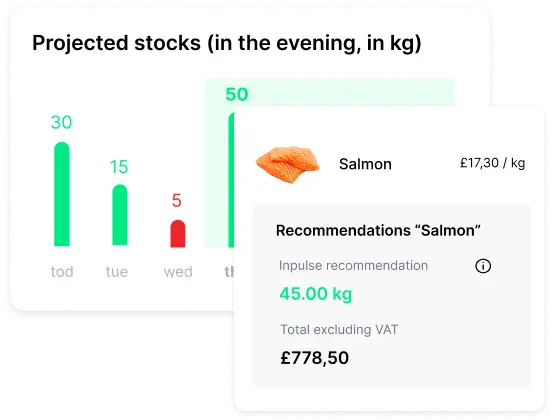
Using an inventory management tool like Inpulse allows you to centralise all your suppliers in one place, anticipate supply needs, easily order and monitor stock levels in real time. You will thus be able to remotely manage the supplies of each of your restaurants.
This centralisation guarantees compliance with negotiated volumes and eliminates quality variations between your establishments. Integration with your restaurant till automates sales tracking and optimises replenishment.
"With Inpulse, everything is integrated into a single software, which saves us a lot of time and allows us to monitor our stocks. It is a tool that has greatly facilitated our inventory, ordering and purchasing management process." Benjamin Attal, co-founder of Franks Hot Dog.
Objective: Standardise production to control quality and reduce costs.
Are you tired of your burgers not tasting the same depending on the restaurant? The solution is the central kitchen. This production laboratory allows you to standardise your recipes, your culinary techniques and the training of your teams. This production standardisation allows for precise cost control and ensures consistent quality.
It facilitates rapid adaptation to market trends. Recipe modifications apply instantly to the entire network without additional training for local teams. You thus guarantee product homogeneity, constant quality and a reduction in preparation costs.
Result: consistent quality, more efficient staff, ingredient savings, simplified inventory management, and therefore reduced food waste.
This organisation also simplifies your food inventory management. Instead of managing 50 ingredients per restaurant, you only have 15 semi-finished products to track.
Objective: Avoid ordering errors that lead to food waste, stockouts and unnecessary cash immobilization… and erode your margin on a large scale.
How many times have you had too many salads that end up in the bin on a Monday, then nothing left for the Friday rush? Ordering errors are the scourge of growing chains.
Ordering errors generate two types of losses: waste from over-ordering and loss of turnover from stockouts. Artificial intelligence reduces these dysfunctions.
Inpulse's artificial intelligence technology predicts future sales and automatically generates supplier orders to have just what is needed in stock. Our algorithms analyse sales history, integrate external variables (weather, school holidays, local events) and calculate optimal needs. This automated prediction adjusts orders according to real conditions. Inpulse allows restaurateurs to order what they need at the right time.
For example, the AI detects that a rainy period increases soup demand by 30% and reduces salad demand by 20%. Orders adjust automatically, minimising waste and stockouts. Without restaurant experience, your new managers achieve their food cost objectives from the first few months. No more stress from poorly calibrated orders and unbalanced stock levels.
Thanks to Inpulse's AI, order just what you need in stock and limit your losses.
{{banner_inpulse}}
Objective: Avoid raw material cost overruns that weigh down your margin
Uncontrolled portion deviations destroy profitability. An excess of 15g of cheese per pizza represents 30% less margin on this item. Portion control equipment (scales, graduated ladles, precise dispensers) standardises preparations. Portioning proteins upon receipt eliminates approximations.
Training and tools are a first step; you will then need to regularly check compliance with technical sheets. Inpulse allows you to analyse the performance gaps of each establishment to verify the difference between theoretical consumption and actual consumption of raw materials, which directly impact your raw material cost. If the theoretical consumption of grated cheese is 50g per pizza and the actual use is 65g, that's 30% less margin! The automatic alert allows for immediate correction.
Objective: Gather accurate field data for effective management.
Implementing rigorous tracking procedures is necessary for efficient stock management. They minimise errors and ensure that essential information is collected for stock analysis.
You’ve duplicated your concept and your know-how—now it’s time to do the same with inventory best practices by standardising operations across your restaurants.
Three key stages of product reference management:
This operational rigor allows you to accurately calculate stock turnover rates and optimise your replenishment policies. Without clear procedures, each restaurant improvises.
The result? It’s impossible to compare performance or identify best practices worth replicating.
Objective: Make decisions based on objective data.
Too many restaurateurs operate blindly, only discovering stock issues at the end of the month—when it’s too late to react. You need real-time management!
Real-time monitoring replaces reactive management.
With software like Inpulse, you can collect and analyse two types of data:
With these insights, you can detect optimisation opportunities and address issues quickly.
Inpulse’s artificial intelligence helps you make informed decisions to improve internal processes, manage promotions, and maintain profitable recipe margins.
Objective: Make staff aware of stock management and turn them into performance drivers.
Effective stock management requires everyone’s participation. Educating employees about the restaurant’s performance goals becomes much easier when performance indicators are shared.
It helps them see how their actions directly impact results and encourages active involvement in improving operations.
To achieve this, transparency is key—share your financial ratios and targets openly.
Some entrepreneurs even offer performance-based bonuses, motivating staff to go the extra mile and stay engaged.
“Equipping teams with tools like Inpulse helps raise awareness. We use performance bonuses distributed to the entire staff when profitability targets are met.”
— Valentin Bauer, Founder of Tripletta Pizzerias
At Inpulse, we’ve designed a solution specifically for growing restaurant networks to automate their inventory management operations.
It’s the first AI-powered platform built for restaurant chains that creates a virtuous feedback loop between onsite teams and headquarters through simplified operations and centralised KPIs.
To explore the full range of Inpulse’s features, get in touch with us for a tailored demo adapted to your concept and management setup.




The all-in-one AI platform that guarantees margins for restaurants chains and bakeries.


Inpulse needs your contact information to let you know about our products and services. You can unsubscribe at any time. For more information, read our Privacy Policy.
© 2026 Inpulse. Tous droits réservés. Legal information
Politique de confidentialité.